Black Magic and Voodoo
Voodoo is a fusion of spiritual and religious practices that originated in Africa and developed different characteristics as it spread to other parts of the world. While its core foundations remain African, each region has shaped voodoo through local culture, history, and religious influence.
Across various traditions, there are individuals who practise forms of magic, witchcraft, and ritual work that may involve manipulating or drawing upon energy. In addition, there are unseen influences that can affect a person’s energetic field if appropriate boundaries and protections are not in place, potentially leaving individuals vulnerable to psychic or energetic intrusion.
West African Voodoo has remained closer to its original roots, as it continues to be practised in the region where it originated. However, even here, the influence of Christianity, particularly Roman Catholicism, has become evident over time.
Louisiana Voodoo developed through the blending of African spiritual traditions with French, Spanish, and Creole cultural influences. Christianity, especially Roman Catholicism, has played a significant role in shaping its rituals, symbolism, and structure.
Haitian Voodoo evolved largely through the experiences of African slaves brought to the region, particularly from French territories. As with other forms, it has been strongly influenced by Roman Catholic beliefs and imagery.
Although the various schools of voodoo share common foundations, they also differ in structure, leadership, ritual practices, and symbolic tools. For example, some traditions use gris-gris, which are sacred amulets believed to provide protection or ward off unwanted spiritual influences.
In other traditions, leadership may be guided by voodoo queens, female figures who oversee religious ceremonies and community spiritual matters.
Certain schools place greater emphasis on physical ritual objects, such as dolls or symbolic representations, while others focus more on interaction with specific deities or lesser spirits. These beliefs and practices vary significantly depending on the school of voodoo and its geographic location.
Voodoo Dolls
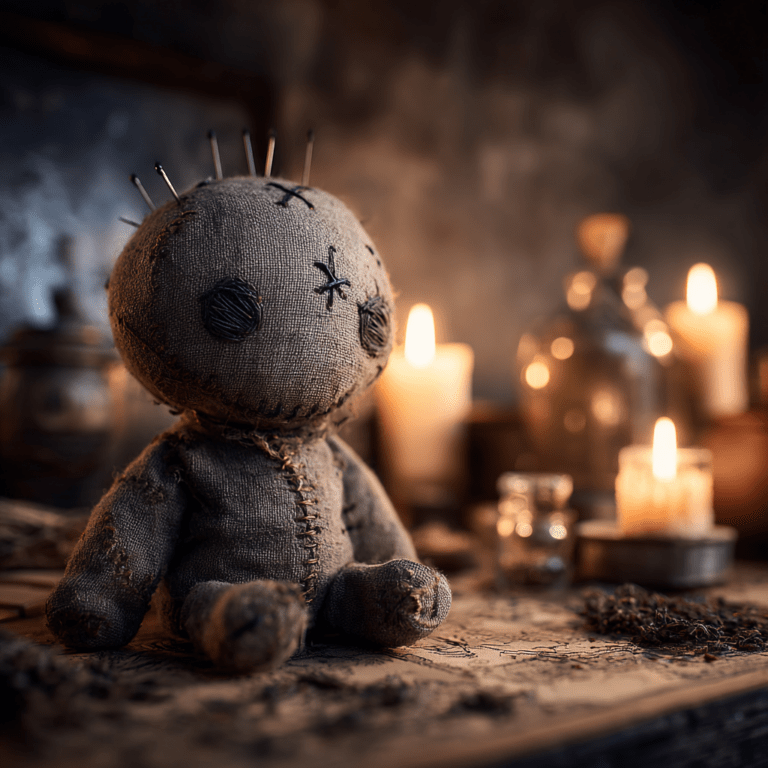
Voodoo dolls are most commonly associated with Hoodoo, a form of African folk magic that blends animism, spiritism, and various religious traditions originating in Africa.
Within Hoodoo practices, dolls have traditionally been created to symbolically represent an individual during ritual or ceremonial work, often with the intention of influencing outcomes through spiritual means.
These dolls have been made from a wide range of natural and everyday materials, including corn husks, potatoes, clay, branches, roots, or clothing stuffed with plant matter. Despite their popular name, voodoo dolls are not universally used across all voodoo traditions, and many practitioners do not work with them at all.
Popular culture, films, and fiction have frequently exaggerated or misrepresented the purpose and use of voodoo dolls, contributing to widespread misunderstandings about their role within authentic spiritual practices.
Black Magic and Voodoo Beliefs
Voodoo beliefs vary significantly depending on the tradition, lineage, and geographic location in which they are practised.
Many voodoo practitioners in West Africa believe in a supreme spiritual source. Over time, this belief has often been syncretised with Roman Catholicism, leading some followers to associate their highest deity with the God of the Bible. Other schools of voodoo do not recognise a singular supreme being, nor do they associate their spiritual framework with Christian theology.
Across all schools of voodoo, interaction with lesser spirits forms a central part of religious practice. These spirits are commonly referred to as loa or miste. There are many families and individually named spirits, and the specific beings engaged with vary according to tradition and location. In regions where voodoo has blended with Christianity, these spirits are sometimes identified through the names of Catholic saints.
Within certain voodoo communities, priests and priestesses hold an important role as spiritual intermediaries. They lead ceremonies, invoke spirits, and guide ritual practices intended to facilitate communication with the spirit world.
Followers of voudon also believe in a universal life force and in the soul’s ability to leave the body during dreams or states of spiritual possession. In Christian theology, possession is generally viewed as negative or malevolent, often interpreted as an external force entering an unwilling person. In contrast, within voudon traditions, possession by a loa is intentional, welcomed, and considered a sacred experience.
When guided by a trained priest or priestess, such possession is regarded as a profound form of spiritual connection and a direct means of communion with the spirit realm.
Voodoo Today
Modern voodoo both influences and is influenced by the cultural environments in which it exists. In West Africa, voodoo continues to be practised in forms that reflect deep syncretism with Christianity while maintaining its indigenous spiritual foundations.
Louisiana voodoo has also merged with Christian elements, while additionally being shaped by American consumer culture. In places such as New Orleans, interest from tourists has led to the commercialisation of voodoo-related items, which are often purchased for novelty or decoration rather than for sacred or ritual use.
Haitian voodoo similarly affects and is affected by its surrounding cultural landscape, both within Haiti and in neighbouring countries, including the United States. As with other forms, it continues to evolve through ongoing syncretism and cultural exchange.
Despite its complexity and spiritual depth, voudon has developed a largely undeserved reputation as a sinister or dangerous religion. While some rituals include animal sacrifice, this practice is not unique to voudon and has existed historically within many religious traditions, including Christianity, Islam, Judaism, and Hinduism.
Ironically, the elements most commonly associated with voodoo in popular culture, such as voodoo dolls and zombies, bear little resemblance to its authentic beliefs and lived spiritual practices.
.